
The scoring talent of Ebuka Okorie under the microscope
Stanford's breakout freshman might not be a one-and-done, but his gaudy scoring numbers are more than meets the eye, for better or worse. Plus, quick hits on five prospects!

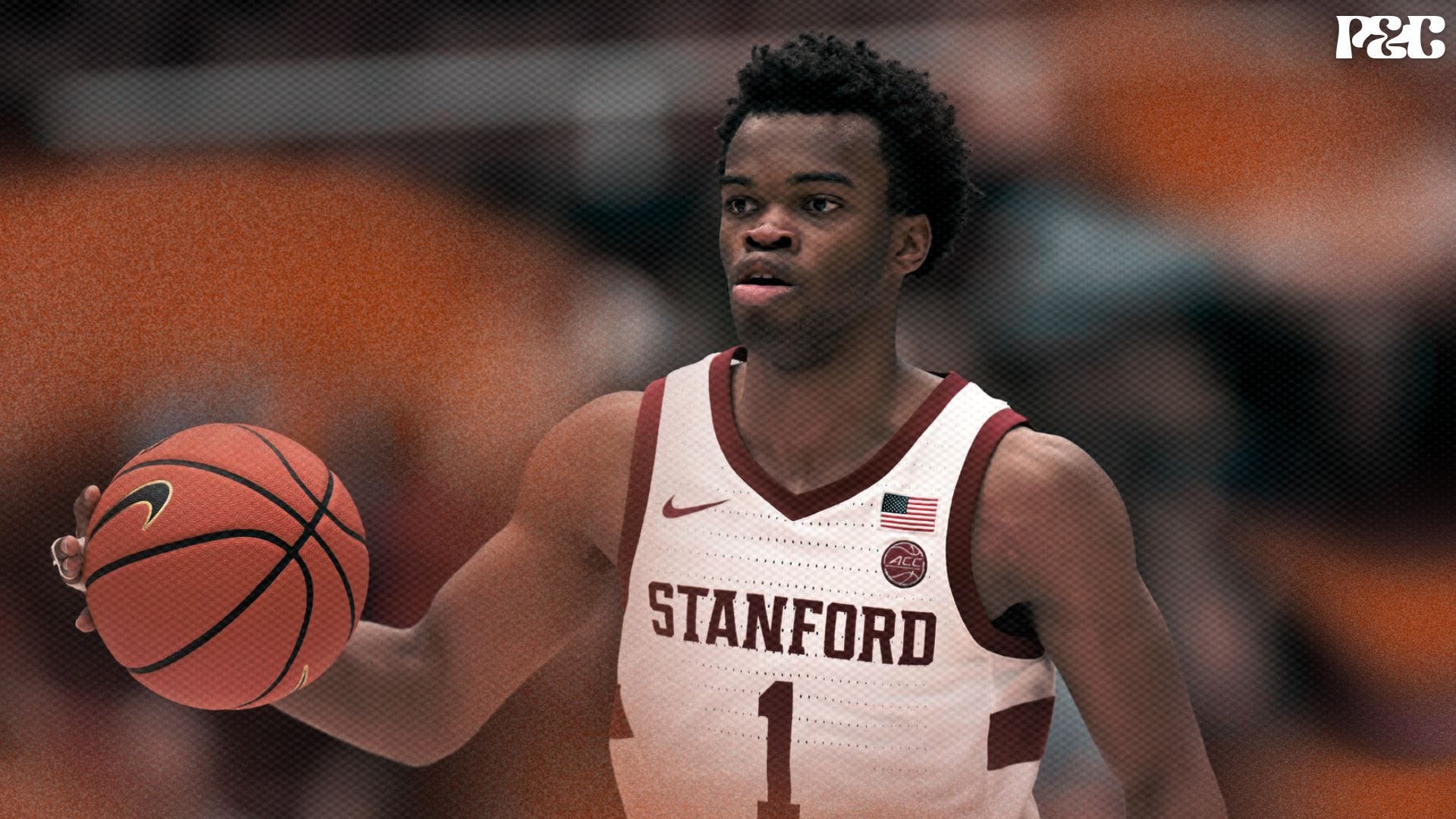
When a freshman makes a splash like Stanford guard Ebuka Okorie has, the nation takes notice. Okorie opened his collegiate career with four consecutive 20-point games—135 minutes to hit the 100-point mark.
Scouts started to take notice. Sure, the highest-ranked opponent he’d faced was Portland State in his season opener, but these numbers weren’t normal. The rush to crack open the film wasn’t too dissimilar to the San Francisco gold rushes. There was little of substance but much of promise; enough to make Okorie a draftable prospect, according to a good number of big boards.
Okorie’s trademark is his scoring. Even though the four games that followed his explosive start include just as many 10-point performances as 20-plus — against much better competition — his 21.4 points per game average is still top-15 in the NCAA, and he’s done it efficiently, too. His 59.8% true shooting ranks in the 75th percentile nationally, and his assist-to-turnover ratio of over three-to-one is among the nation’s best.
Okorie’s scoring dominance starts with his burst. Despite being smaller at 6 feet, 2 inches, and a shade over 180 pounds, nearly half of Okorie’s field goal attempts have come at the rim. His 52.6% shooting percentage around the rim grades out at below average, but it’s led to easy points at the line, with Okorie posting a 0.50 free-throw rate (83rd percentile).
Okorie self-creates the vast majority of his rim attempts — 96.7% of them to be exact. He’s a threat to get to the rim at a moment’s notice, getting past the free-throw line on a simple bull rush to the basket, splitting a screen or by keeping his handle alive to mix his way past with a bevy of moves.
Results have been varied, and Okorie’s ability to attack longitudinally comfortably exceeds his latitudinal prowess. Most of Okorie’s finishes are of the underhanded variety, off the opposite foot and from right under the rim. At his size, having registered zero dunks even out in transition, mixing up these finishes with goofy/same foot layups, floaters and even a running hook should be on the bucket list for Okorie.
Per Synergy, in his last two games, against Saint Louis and Portland (the former a quad-one win for Stanford), Okorie went 0-for-6 at the rim in the half-court. Before that pair of performances, Okorie had more games with four or more shots made at the rim than games with three or fewer. The mixed results are likely a symptom of playing against more size and being a more featured piece of the opponent’s scouting report, though Okorie’s touch could stand to improve.
That said, his vigor around the rim is matched by an inherent toughness and willingness to be the first to dish out a bump. As it stands, Okorie’s an average finisher with a high ceiling, given his burst and proficiency getting to the rim already.
While Okorie’s gotten to the rim at an elite rate, his ability to spray from downtown has been just OK thus far. He sits at a 38.5% 3-point attempt rate, 35th percentile, hitting a third of his shots and creating a third of those makes.
Okorie has a relatively smooth shot. It comes across his body slightly, and is very much a two-motion release, but the follow-through is clean with seemingly little lost energy on the way up.
The issue in Okorie’s shot is the prep. When off the ball, Okorie’s rarely ready to fire at a moment’s notice. If not involved in an action, he’ll stand with his hands at his sides, waiting for the ball. The lack of prep has led to both a lack of volume on catch-and-shoot 3’s, needing additional time to get into his form, but also easier to defend overall at the point of attack.
The ability to get into his shot off the dribble has also been worrisome, especially from beyond the arc. Okorie has taken 32 dribble jumpers, over a fourth of his shots from the floor, making 31.3% — 23.8% from 3-point range.
The majority of Okorie’s effectiveness lies in his ability to get to the rim and to the free-throw line, generating the game’s easiest shots at will. The overall polish and ability to fully navigate his lack of size haven’t yet come, but the signs of a truly elite scorer, not just a prolific one, are there.
As of now, Okorie doesn’t stand out as a surefire one-and-done, especially with just one high-quality matchup under his belt. That said, Okorie has a ton of potential, and whether his time as an NBA player starts in 2026, 2027 or any year past, there’s a lot to look forward to with what he brings to the floor.
