
Killyan Toure: growing on a diet of All-American matchups
Potential lottery-pick Bennett Stirtz had the worst game of his Division-I tenure against Iowa State, in no small part due to the lockdown defense of freshman Killyan Toure.

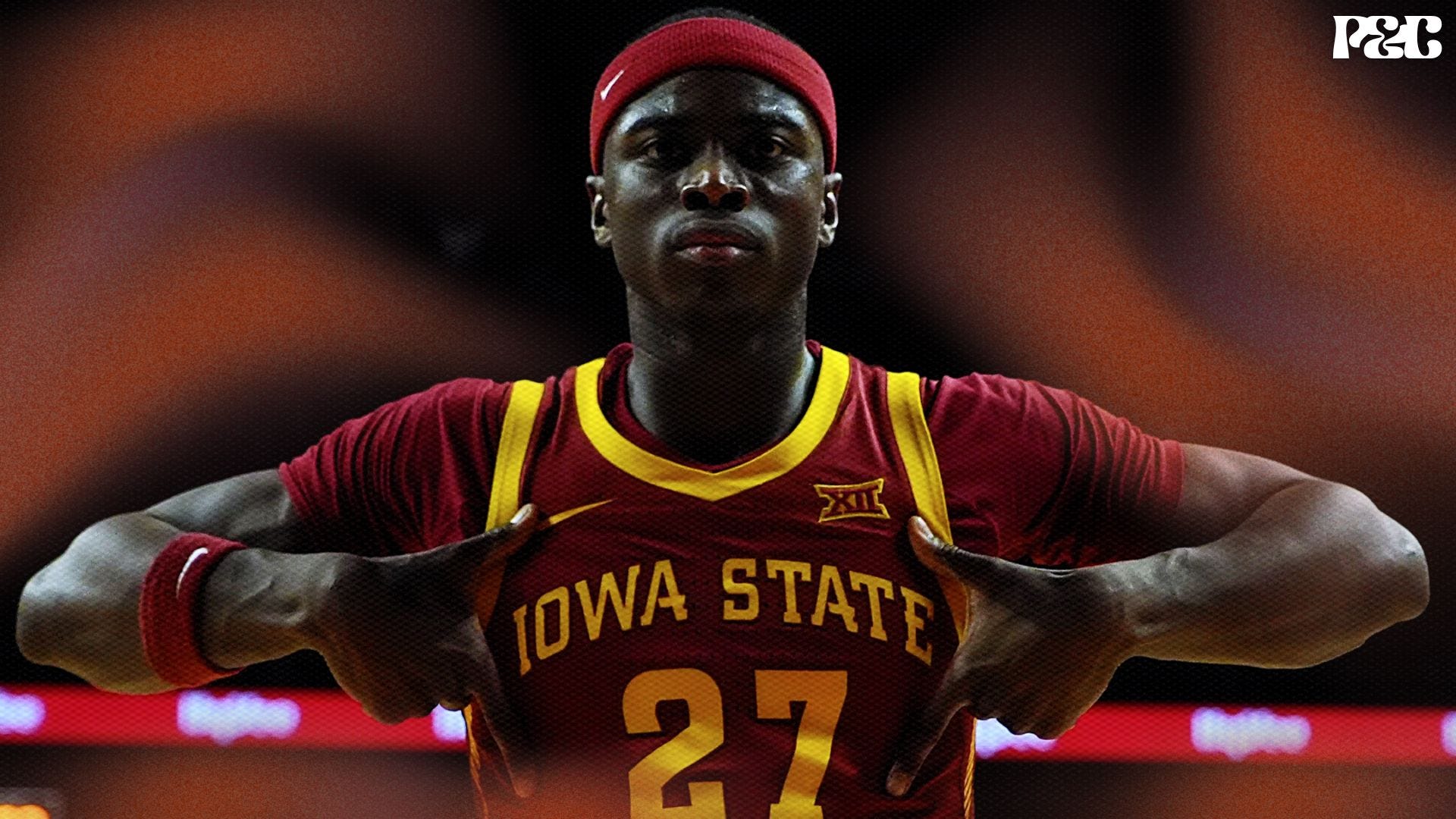
Just like in the NBA, it’s not often players come into the NCAA and are immediately known for what they bring on the defensive end. Iowa State freshman Killyan Toure is one of those rarities.
Toure wasn’t a household name coming out of Brewster Academy. He was a four-star and the 180th-ranked player in 247Sports’ composite rankings, even falling from his peak as the 157th-ranked player back in April to the close of the cycle in August.
At 6 feet, 3 inches, Toure was an underwhelming offensive piece, who didn’t create much on the ball and didn’t excel as a primary playmaker. He was a great athlete with a head of steam, long arms and an intense motor, but the skill lacked refinement, and his ranking reflected that.
The expectation was that Iowa State would bring him along slowly, allow him to adjust and develop while the offense caught up to the defense for a T.J. Otzelberger team that wanted to contend. He made noise throughout the offseason, but when it was announced he’d made the Cyclones’ opening night starting five — playing 28 minutes in an 88-50 win — it still came as a surprise.
As it’s turned out, Toure’s defense has been more than enough to make up for a less-than-complete offensive game, which has still allowed him to get to 11.5 points per game on mostly cuts, straight-line drives and transition takes, while making a healthy 39 percent of his limited 3-point attempts.
To be a true NBA prospect, Toure will have to develop on the offensive end, but early on, he’s made a name for himself as a boogeyman for any caliber of primary ball-handler.
Toure’s last game against Iowa, where he scored just 7 points (1 off his career-low of 6), was perhaps his biggest showcase yet of what he brings to the defensive end. Against potential lottery pick Bennett Stirtz, Toure put on a masterclass of on-ball defense, holding Stirtz to his worst game of the season.
The scoring talent of Ebuka Okorie under the microscope

When a freshman makes a splash like Stanford guard Ebuka Okorie has, the nation takes notice. Okorie opened his collegiate career with four consecutive 20-point games—135 minutes to hit the 100-point mark.
Toure opened the game against Iowa as Stirtz’s primary defender — a message of the trust Otzelberger has in the freshman off the bat, given the presence of two-time Big 12 All-Defense selectee Tamin Lipsey in his backcourt.
Toure isn’t the biggest guard in the world, even giving up a couple of inches to the 6-foot-5 Stirtz, but at 205 pounds with incredibly long arms and bushels of hustle to go around, Toure was the perfect matchup.
Stirtz is one of the nation’s highest-volume pick-and-roll ball-handlers, ranking in the 98th percentile in volume and the 75th in efficiency. Per Synergy Sports, 17 possessions running the action against Iowa State, Iowa still managed 18 points (1.058 points per possession), yet it’s difficult to put Stirtz’s performance at the forefront of that.
Toure fought through screens like his life depended on it. He always had a limb attached to Stirtz, and rarely opened his hips as he closed gaps at lightning speed. After the first three pick-and-rolls Iowa ran through Stirtz scored 8 points, Toure turned it up, forcing back-to-back turnovers on the Hawkeyes’ point guard.
Often, the difficulty in playing through a one-on-one stopper like Toure on defense is the fact that basketball is played five-on-five. It’s borderline impossible to maintain a singular matchup in the minutes those two players share, both because switching just happens, and because most offenses are able to score consistently in four-on-four situations.
The difficulty for Iowa comes in its reliance on Stirtz to get the faucet flowing, with success for Iowa State coming in their deployment of Toure almost exclusively above the break. If Stirtz was off the ball and flowed to the corner, Toure would switch, waiting for a pin-down or another action that brought Stirtz up above the break to switch back on and cause havoc.
It was a decision of schematic genius by Otzelberger, knowing Stirtz got to nearly all his offense between the half-court line and the free-throw line. Additionally, Stirtz isn’t a knockdown shooter from the corners, nor is that where his shots typically come from.
Per CBBAnalytics, Stirtz shoots just 33.3% on corner 3s, taking about a third of a shot per game, compared to 44.6% on above-the-break 3s, which he takes at a rate of nearly six per game.
Any time Iowa wanted to get to Stirtz, holding him in the corner, hoping Toure would venture off or make a freshman mistake and forget his assignment, he would be there. Stirtz played all 40 minutes in the 66-62 loss, Toure sharing 30 of those minutes with him, almost all of them matched up against him on defense.

Stirtz ultimately finished the game with 10 points, four assists and three turnovers, notching a game score of 4.8 (lowest of his career) while Toure finished with 7 points, five rebounds and two steals.
The game was emblematic of both Stirtz’s shortcomings and Toure’s strengths. Stirtz, on one hand, struggled to get below the free-throw line, playing with his trademark pace but faltering against the length and energy of Toure.
Toure’s tools made him perfect on paper for the matchup, yet it was his technique and energy, along with his execution of a game plan made to cut off Iowa’s generator, that allowed him to win it.
His shortcomings offensively may keep him out of pro consideration for another year or two, as he becomes more comfortable handling and running the show, fixing his lackluster shooting mechanics, but his strengths have put him on radars as a long-term guy to keep track of.