
What constitutes a No. 1 pick?
Cam Boozer might not be a 1A scoring option, and he surely isn't a lockdown defender. Despite this, he's arguably the most worthy top pick in the 2026 NBA Draft.

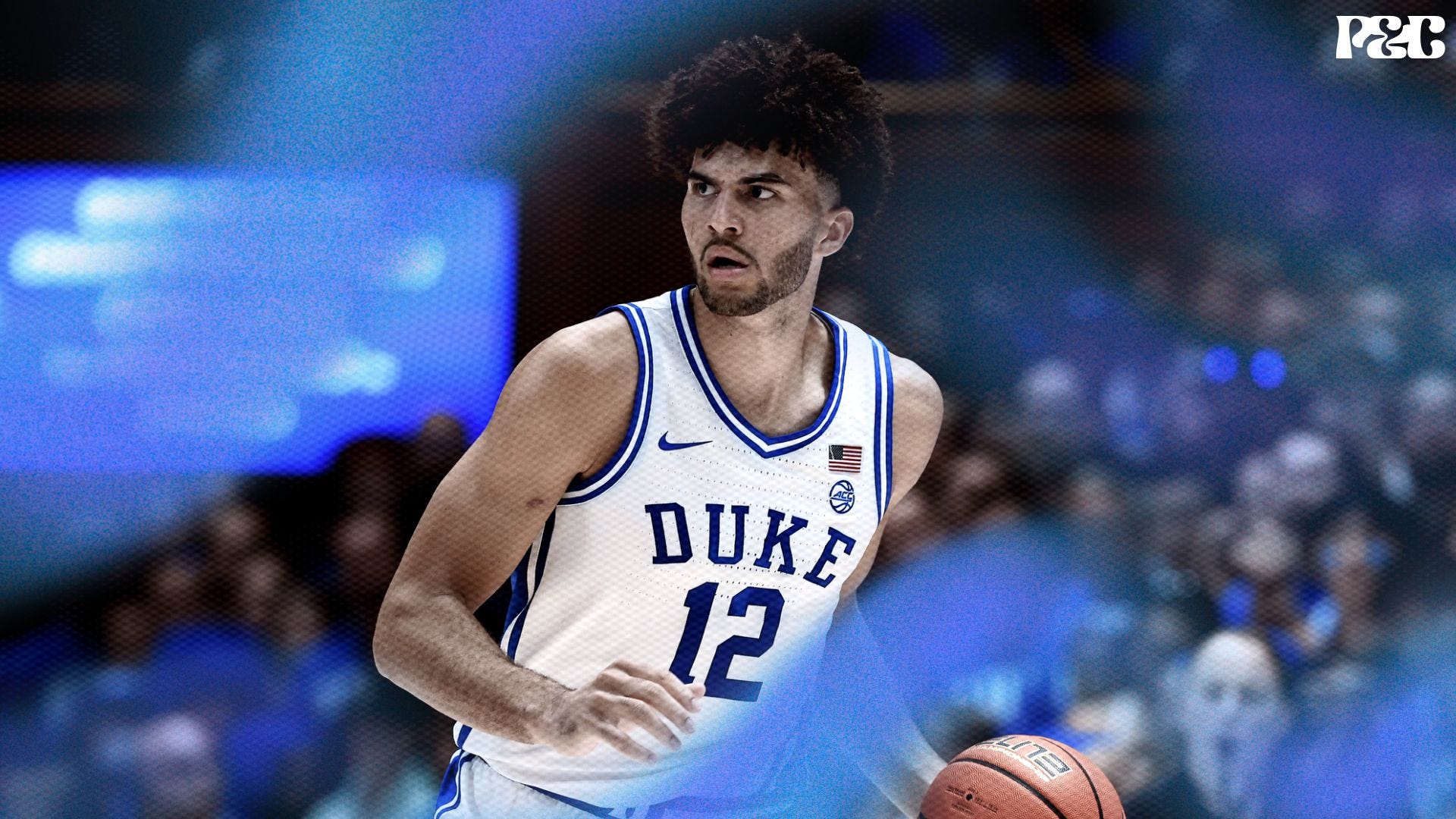
It’s not often I get to call myself a huge fan and a careful skeptic of a prospect simultaneously. Typically, I fall into one of those bins, with players finding themselves somewhere on my board corresponding to my alignment with them.
I am simultaneously skeptical and head over heels for Duke star Cameron Boozer.
Boozer’s been the most productive player in college basketball, and the only prospect on Duke that hasn’t, to some extent, failed to meet expectations. He’s averaging 23.3 points per game, the highest mark in the nation, on remarkable efficiency, while leading the third-best team in the country in every other major stat category besides blocks.
He’s magnificent. Around the rim, he has the force of a sledgehammer and the precision of a scalpel. He processes the game with honed speed and forgoes the transition between defense and offense with his ability to blend rebounding and full-court passing like a Renaissance painter blends colors.
That said, the projectable markers of superstardom aren’t always as omnipresent for Boozer as they seem to be on the box score. He lacks as a self-creator, and his shortcomings defensively show why margins matter.
These are things that, while I recognize them, and without discarding them, I still find myself settling on Boozer as the first name I’d call in the 2026 NBA Draft.
Boozer for me represents what constitutes a No. 1 pick — what makes someone stand out among their peers as a present yet projectable star in the making, while recognizing that there’s no surefire formula for what makes somebody great. Boozer isn’t like the top prospects that came before him in many ways, but he’s still deserving of the same honor.

Boozer’s impact starts as a play-finisher. By my own definition, a play-finisher is exactly what it describes: somebody who is rarely initiating possessions, but finishing them. This can come in the way of shots off assists, put-backs, rebounds themselves, or, in certain settings, passes. By this definition, Boozer may be the best play-finishing prospect since at least Chet Holmgren, and potentially far beyond.
Initiators capture the attention of viewers and scouts early. They bring the ball up the court, size up defenders and score the kinds of buckets kids try to emulate in their driveway. For that reason, these players tend to be marked as future stars from the jump. From Anthony Edwards to Cooper Flagg, these are the type of offense-first prospects that top draft boards.
Even in the ‘26 class, Darryn Peterson and AJ Dybantsa, Boozer’s greatest peers and rivals for the top spot, are favored, largely due to their star-like profiles as initiators.
However, play-finishers can be stars too. Even offensively-slanted ones like Boozer.
Boozer’s come out as an 80th percentile finisher at Duke, using savvy footwork and feather-light touch to secure a variety of buckets around the basket. Early on, in games against Tennessee and Kansas, Boozer struggled under the basket, lacking elite explosiveness to guarantee dunks.
Though as the sample’s grown, Boozer returned to the caliber of finisher he was in high school. As mentioned, Boozer’s footwork is immaculate, and his touch feathery, but he also has the strength to carve out space and a nose for the glass that helps him follow his own misses just as well as his teammates’ misses.
Layups are the easiest shots in basketball, on paper and in reality. Boozer makes and generates them at a high rate. In fact, Boozer’s seldom taking or passing for difficult shots, both as a shooter and playmaker.
Nearly 90% of Boozer’s own field goal attempts have been at the rim or beyond the arc, and over 95% of his assists have come on shots in the same areas. Boozer’s 3-point shot itself is a work in progress. He shoots from a wide base with a rickety two-motion release. The ball comes off his hands smoothly, but at a far too upward angle, creating an unreliable trajectory.
That said, Boozer shoots it well from the line, and his touch around the rim suggests future improvements from beyond the arc. He’s not a non-shooter, confident from deep, while knowing he’s not Stephen Curry, but having just made a third of his threes, there’s still room for improvement.
The most concerning part of Boozer’s game is his self-creation. Boozer lacks the East-to-West shift and mobility of a traditional go-to scorer, with a glaring black hole in the middle of his shot chart. If it isn’t a 3-pointer or a layup right under the rim, Boozer doesn’t take it. That’s great for efficiency, but not as desirable for high-volume, high-usage stars, who can live on shots in the middle of the floor in late-clock or advantage situations.
The continuing question is, how much of that is required to be a star? Given what Boozer brings as a play-finisher, I’d say it’s a cherry on top in the top-pick formula, with some serious give-and-take being played.
Luckily for Boozer, he’s also a tremendous playmaker — another massive cherry on the sundae of superstardom. He sees the full court as a passer and is a threat to fire to a teammate from the moment the offensive possession starts.
Some, including myself, have called him the best pre-NBA outlet passing prospect since Kevin Love. In the half-court, he’s a perfect hub above the break, reading and reacting in hand-offs with the capability to go up and over or slide the ball into the most minuscule windows.
Stars come in all shapes and sizes, as do top prospects. Not one top player in the league looks or plays like another, at least to the degree of a one-to-one comparison, but there is a through-line: playmaking.
From Nikola Jokic to LeBron James and Stephen Curry, across the entire positional spectrum, stars can pass the ball. They may not be perfect, lead playmakers — the league’s reigning MVP, Shai Gilgeous-Alexander, doesn’t always spot the most basic passes — but they feel the game, not just space as a scorer or another singular facet.
Boozer represents this single, inalienable star quality better than any of his top-ranking contemporaries in the 2026 class; perhaps better than any No. 1 pick since Cade Cunningham in 2021.
Boozer comes equipped with weaknesses, as all players do; some we’ve already discussed. His lack of side-to-side wiggle limits his creation, and his burst off the floor has kept him from being an explosive finisher around the rim.
While burly-bodied and strong, with tree-trunk legs and an alleged 7-foot-1 wingspan, that lack of burst and wiggle has limited him most on the defensive end.
He’s not a space eater, and never will be, with more calculation in his choice of steps than athletic mastery. The top bigs in previous classes — Alex Sarr, Victor Wembanyama, Chet Holmgren, Evan Mobley, etc. — all functioned as elite shot-blockers, standing close to or well over seven feet tall.
Boozer isn’t that. If that’s what you were looking for at the top of the class, you’d go with UNC’s Caleb Wilson or Kentucky’s Jayden Quaintance, neither of whom possesses the clear, inalienable star qualities Boozer has, no matter how atypical he is as a scoring and defensive prospect.
That said, it is worrisome how Boozer has scaled. Against high-major opponents (Big Ten, Big 12, SEC, ACC, Big 12), Boozer recorded just nine steals and three blocks (2.0 stocks per game), compared to 11 steals and eight blocks against just as many mid-major opponents (3.1 stocks per game).
There are noteworthy strengths to Boozer’s defense. His quick thinking on offense translates to having great hands in passing lanes and against would-be post scorers. His strong lower body has made him difficult to move, and he generally has a good sense of where to be. Of course, his rebounding is his strongest way of ending opposing offensive possessions as well. It’s just a question of how much the raw athleticism truly matters.
What shouldn’t be questioned, however, is Boozer’s impact. At 18 years old, he’s the best player in college basketball, the nation’s leading scorer, a walking double-double and the fulcrum and centerpiece of one of the nation’s best teams.
None of those things is a surefire marker of a star, nor do they inherently make someone deserving of top pick honors. But, then again, is there any single attribute, award or trait that signifies any form of success? Consensus is split.
Despite the wishy-washy-at-best predictive factors of stardom, Boozer has put forth an excellent resumé through his first 12 collegiate games, and in the four years of high school dominance that preceded it.
All things considered — atypicality and shortcomings not often associated with a top pick — Boozer, in my eyes, is the most deserving top prospect in an abundantly strong 2026 NBA Draft class.